Tuesday, December 13, 2005

Frank Furedi ~ On the Hunt for a Conspiracy Theory

From ChristianScienceMonitor.com

Conspiracy theory has captured the public imagination. Often we are less interested in what politicians say or do than in attempting to decipher the hidden agenda that motivates their behavior.

Every Supreme Court nomination turns into a search for the skeleton in the closet or a trace of a conspiracy. No sooner was Harriet Miers nominated before rumors suggested that President Bush used her as a fall guy whose failed nomination would make it more difficult for liberals to discredit her more conservative replacement. The president may have more than one conspiracy up his sleeve. It has been suggested that the avian flu scare is promoted by the White House to distract the nation from a messy war in Iraq. Others hint that the pharmaceutical industry is behind it to profit from an explosion of demand for flu vaccines.

Conspiracy theories are now so influential that the US State Department's website desperately tries to contain the damage these theories cause to the reputation of the United States. It recognizes that conspiracy theories have "a great appeal and are often widely believed." Indeed, the theory that American foreign policy is the outcome of a carefully elaborated secret plot concocted by a cabal of neoconservatives is widely believed both inside and outside the US. Preoccupation with conspiracies is no longer confined to the margins. Virtually every unexpected event provokes a climate of suspicion that breeds rumors and conspiracies.

More here

Graeme Jamieson ~ Situation Istiophoridae

Hi
What about Higher, baby?
Where you from?
I thought Southside
You said suicide
Suicide?
Nah, just Southside
Good, I’ll get Bensonhurst on my speed dial
And all the while, you can call me ragazzo
Or even peccadillo
So long as you don’t start the meter again
I’d rather save you the dime
If you can’t give me time
I figure I came over profligate
And if it happened again
The residue of my reputation would begin to erode
I think we’re wiser getting consonant with our innermost beings
For the meantime
I sense that
Nothing in a barrel of tele-casuistry holds any water
So let’s scribble before nibbling ear-to-ear
Its a situation complicated by its straightforwardness
But by the Fall
I’ll take you a fine line around the island
Through the doormen in my pocket
And if you’re thinking
He thinks money is part of everything
Let me tell you
It is not everything in anything
By now though
I suppose you know the family of my name
It’s Gambino
Yes, you’ve been told
Yet assumption is no formidable currency of accusation
Black Cadillacs pull out of graveyards everyday
So forget any clemency
And Kensico Cemetery
They tell me no one ever digs Valhalla anyway
See that life for me is now far away
He took one in the mouth for his clarion bawling
You use that language in front of my mother’s son?
They said
You show a lack of respect
They were talking to my uncle
His temerity had no value as a precedent
But he was my uncle
So a precedent had to be set
And that was that
They secured my debt
Next day I thought
How can I replace the old order?
When I am becoming a product of it
"A microcosm of their macro malaise”
Six words Eugene Ionesco conceived to phrase
When back-in-the-day
He outlined why he pined to pit from their race
So I said Messrs Gotti, I want away
To wash these nephew hands of this thing of yours
After all that happened yesterday
Tomorrow
I shall convene my own epoch
When I begin to become a scholar
So they said
It gives no pleasure whatsoever kid to remind you of
Castellano
He said to Piney
He said
I know what he said: ‘You don’t get to do everything. You won’t. No one does. Me, I got no regrets. The thing I wish, I wish I had more education.
I wish I was more, ya know, educated.’
That’s right sonny
Well Great Uncle P is not Master G
Hear me out, willya, please
I must stand at ease
And guess what?
They stood aside
So know Ms Po what you’ll find in me
Is an independent mind, a ragazzo who is free
Given up bottles of contraband booze
Their rackets
Pay packets
Are done and defused
That since is now eliminated
Today, I surfeit on the city
Where I hold more water with a clear head, a piece of paper and a pen
Than a piece alone
We’ll take the long road then
And walk it
So; gorgeous girl
With the golden gaze
Now you know me better
Don’t pick up the phone, the knife or the dish
Let me alone to count my change
For that Swordfishing meter

Nate Mezmer ~ If a Black Man Dies in America, Does It Make a Sound? Killing Tookie Williams

from CounterPunch.org

If Stan Tookie Williams is executed tomorrow who will feel the negative effects? Most of those who support his state sponsored murder do not live in war torn regions of the Golden State of California. Thus it is difficult for these privileged people to understand the benefits of Stan's contributions on behalf of non-violence. However, because blacks are sentenced to death twice as frequently as whites who've been convicted of the same crime it appears that this may be more than a misunderstanding.

If a young black man is shot in South Central does it make a sound in Thousand Oaks?

If Stan Tookie Williams is executed tomorrow who will feel the negative effects? Stan was convicted of four murders 25 years ago in connection with armed-robbery however the key witnesses were felons who recieved 'benefits' in exchange for their testimony ( facts of the case). I have encountered many people who say that since Stan was a gang-banger and a co-founder of the Crips that such facts alone should condemn him despite his transformation. This notion is almost laughable if it were not so dubious, especially in light of the fact that our own country, the United States of America, is currently disguising the hostile takeover of oil-rich Iraq as a righteous crusade for freedom.

If a young black man is shot in Hunter's Point does it make a sound in Hillsborough?

If Stan Tookie Williams is executed tomorrow who will feel the negative effects? The current administration in the White House is the most mafia regime in the history of the country and is thus run by some of the biggest gangsters in the world. The war in Iraq, a war based on falsehoods and conspiracies, collusion and neglegence, has been responsible for the murder of thousands of innocent civilians and has taken the lives of more than 2,100 US soldiers. This being said, no one is calling for the execution of the president?

If a young black man is shot in Watts does it make a sound in Orange County?

If Stan Tookie Williams is executed tomorrow who will feel the negative effects? Indeed, lessons in retribution and justice in the form of war and execution never seem to get the job done. After, 9/11 we haphazardly attacked two countries, enraging large portions of the global community and subsequently created a greater terror threat than had existed before. Maybe if we had stopped to understand why the attacks had occurred in the first place our nation and its soldiers would not be in the same deadly predicament? Furthermore, because violence begets violence, as the bumper sticker says, "why do we kill people who kill people, to show that killing people is wrong?"


more here

Monday, December 12, 2005

Frank Furedi ~ The Age of Unreason

from FrankFuredi.com

Celebrities, healers and new age gurus transmit the message that normal human beings cannot do it on their own.

To this day I am astonished when I hear that sensible, biologically mature adults allow themselves to be treated as if they were incompetent dimwits by a new army of professional surrogate parents. In days of old, traditional authority figures, like priests, instructed us how to behave in public and told us which rules to observe. Today’s experts are even freer with their advice. They do not simply tell us what to do and think, but also how to feel. A new army of life coaches, lifestyle gurus, professional celebrities, parenting coaches, super-nannies, makeover experts, healers, facilitators, mentors and guides regularly lecture us about the most intimate details of our existence. They are not simply interested in monitoring public behaviour but in colonising our internal life.

Life coaches ‘support’ us with making transitions in our private life while their colleagues feng shui our mundane existence. And every aspect of daily life has become a target of a makeover project. It is sad to see grown-up people needing somebody to show them how to shop for clothes. It is even more depressing when so many of us decide that we cannot make important decisions concerning our personal life without the benefit of a life coach, parenting coach or a high-tech psychic peddling gemstone therapy. This is not just deference to authority but the prostration of the adult imagination.

Of course, there is nothing wrong with expertise. We rely on mechanics to fix our cars and on dentists to extract our teeth. But the posse of 21st-century life experts is not so much in the business of fixing practical problems as in transforming us into needy children. Their enterprise depends on undermining and usurping confidence in our ability to conduct our affairs. The message they transmit is that normal human beings cannot do it on their own. That is why they assume that they possess the moral authority to dictate to us what to wear, how to love, how to parent, what not to eat and, most important of all, how to live. They are in the business of imposing a new form of authority over people’s everyday affairs. At least the message of self-help gurus in the 1980s and 1990s projected the mildly anarchic ideal of ‘be yourself’. In form at least the message was promoted through an anti-authoritarian vocabulary. In contrast, today’s makeover culture self-consciously commands you not to be yourself. On television they make fun of the way you dress, offer sarcastic references about your poor taste in the way you furnish your home and insist that you follow their superior regime of child-rearing. They know best, which is why some of them describe themselves, without a trace of irony, as gurus.

Deference to the authority of the celebrity, makeover guru or healer is underwritten by the decline in the influence of conventional forms of authority. That is why the frequently asserted claim that we live in an age characterised by the ‘death of deference’ bears little relationship to reality. Yes, it has become fashionable to treat traditional forms of authority — monarchy, church, parliament — with derision. Criticism of traditional institutions has become so prevalent that it bears all the hallmarks of classical conformism. Scientists, doctors and other professionals have also experienced an erosion of authority. But the diminishing influence of conventional authority has been paralleled by the rise of a new ‘alternative’ one. We don’t trust politicians but we have faith in the pronouncements of celebrities. We are suspicious of medical doctors but we feel comfortable with healers who mumble on about being ‘holistic’ and ‘natural’. We certainly don’t trust scientists working for the pharmaceutical industry but we are happy to listen to the disinterested opinion of a herbalist. And, of course, alternative food and other consumer products gain our confidence because ...they are alternative.

more here

Random Transmissions 5: Eco & Baudrillard

To love someone is to isolate him from the world, wipe out every trace of him, dispossess him of his shadow, drag him into a murderous future. It is to circle around the other like a dead star and absorb him into a black light ~ Jean Baudrillard

A narrator should not supply interpretations of his work; otherwise he would have not written a novel, which is a machine for generating interpretations ~ Umberto Eco

Either you have not to be serious and seem it, or to be serious and not seem it. Those who combine being serious with seeming serious are insignificant ~ Jean Baudrillard

I've always said that I learned the English I know through two sources -- Marvel Comics and Finnegans Wake ~ Umberto Eco

Some idea swimming in the blue gelatine of the reptilian brain, seeking out the gossamer-thin difference between illusion and the real ~ Jean Baudrillard

The author should die once he has finished writing. So as not to trouble the path of the text ~ Umberto Eco

The zealous enemies of stupidity have forgotten that it is both the illness and the vaccine, and that you have to have been inoculated with it to be able to exorcise it. And because it is extraordinarily contagious, you can't rage against it without falling into its trap.
A special mention must go to second-degree stupidity, that stupidity which has already turned around upon itself and come out on the other side reinforced by a whole sophisticated and ironic critical apparatus of intelligence and culture ~ Jean Baudrillard

I would define the poetic effect as the capacity that a text displays for continuing to generate different readings, without ever being completely consumed ~ Umberto Eco

Perhaps our eyes are merely a blank film which is taken from us after our deaths to be developed elsewhere and screened as our life story in some infernal cinema or dispatched as microfilm into the sidereal void ~ Jean Baudrillard

Lying about the future produces history ~ Umberto Eco

The specific idiocy of our time is, sadly, no longer differentiated from its intelligence. It is merged with it. It is no longer uneducated, but is indeed overinformed and has the same reflex vivacity as artificial intelligence. It is the degree Xerox of stupidity which merges with the degree Xerox of intelligence ~ Jean Baudrillard

When all the archetypes burst out shamelessly, we plumb the depths of Homeric profundity. Two cliches make us laugh but a hundred cliches moves us because we sense dimly that the cliches are talking among themselves, celebrating a reunion . . . Just as the extreme of pain meets sensual pleasure, and the extreme of perversion borders on mystical energy, so too the extreme of banality allows us to catch a glimpse of the Sublime ~ Umberto Eco

Memory is a dangerous function. It retrospectively gives meaning to that which did not have any. It retrospectively cancels out the internal illusoriness of events, which was their originality. But if events retained their original, enigmatic form, their ambiguous, terrifying form, there would doubtless no longer be any history ~ Jean Baudrillard

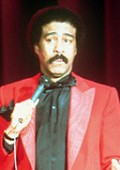
R.I.P. Richard Pryor


"It's been a struggle for me because I had a chance to be white and refused."

from Salon.com:

"He was a funny motherf---er"

Miles Davis on Richard Pryor
I met a young black comedian who was doing an opening act for some of our concerts, Richard Pryor. Man, he was a funny motherfucker. He didn't have a reputation yet, but I knew he was going to be a big star. I could just feel it in my bones. I booked our band into the Village Gate and hired Richard to open for us. I have forgotten where I first heard him, but I just wanted people to know how great this motherfucker was. I paid him out of my own pocket and produced the whole thing. I think we were there for two weekends and the band and Richard just tore the place up. Richard opened and then we had some Indian music played by this sitar player and then my band played. It was really successful and I even made some money on the whole thing. Richard and I became good friends after that, and we would hang out and get high and just have a great time together. (New York, mid-1960s)

From "Miles: The Autobiography," by Miles Davis with Quincy Troupe (Simon & Schuster, 1989)

more here

Kurt Vonnegut ~ Your Guess is as Good as Mine

From InTheseTimes.com

Some of the loudest, most proudly ignorant guessing in the world is going on in Washington today. Our leaders are sick of all the solid information that has been dumped on humanity by research and scholarship and investigative reporting.

They think that the whole country is sick of it, and they want standards, and it isn’t the gold standard. They want to put us back on the snake-oil standard.

Loaded pistols are good for people unless they’re in prisons or lunatic asylums.

That’s correct.

Millions spent on public health are inflationary.

That’s correct.

Billions spent on weapons will bring inflation down.

That’s correct.

Industrial wastes, and especially those that are radioactive, hardly ever hurt anybody, so everybody should shut up about them.

That’s correct.

Industries should be allowed to do whatever they want to do: Bribe, wreck the environment just a little, fix prices, screw dumb customers, put a stop to competition and raid the Treasury in case they go broke.

That’s correct.

That’s free enterprise.

And that’s correct.

The poor have done something very wrong or they wouldn’t be poor, so their children should pay the consequences.

That’s correct.

The United States of America cannot be expected to look after its people.

That’s correct.

The free market will do that.

That’s correct.

The free market is an automatic system of justice.

That’s correct.

And so on.

If you actually are an educated, thinking person, you will not be welcome in Washington, D.C. I know a couple of bright seventh graders who would not be welcomed in Washington, D.C.

More here

Sunday, December 11, 2005

Harlem Shuffle: Hot Joints from the Beat Barbeque


Live and direct from Casa del ionesco's boomin' system:

Pack Up ~ Lyrics Born (featuring KRS One & Evidence)

My Favorite Mutiny ~ The Coup

Lady Don't Tek No ~ Latryx

A2G ~ Blackalicious

At the Helm ~ Hieroglyphics

Thursday, December 08, 2005

Harold Pinter: Nobel Lecture ~ Art, Truth & Politics

from NobelPrize.org
In 1958 I wrote the following:

"There are no hard distinctions between what is real and what is unreal, nor between what is true and what is false. A thing is not necessarily either true or false; it can be both true and false."

I believe that these assertions still make sense and do still apply to the exploration of reality through art. So as a writer I stand by them but as a citizen I cannot. As a citizen I must ask: What is true? What is false?

Full text
here

Video: (please note these are Real Player files)
high bandwidth
low bandwidth

Harold Pinter Home Page

The Messenger Boy For The Dark Players

from SpikeMagazine.com

Craig Johnson talks to Ralph Steadman about the death of Hunter S. Thompson, paranoid flashes and the "terrible betrayal" of modern politics
"One of the reasons he's fun to work with - he has a really fine, raw sense of horror. By way of exaggeration and selective grotesquery. His view of reality is not entirely normal. Ralph sees through the glass very darkly."
Dr. Hunter S. Thompson, June 1974

One of the many facets that sets Hunter S. Thompson's 70s works apart from other forms of classic American literature are the growling, snarling, punch-between-the-eyeballs illustrations of Ralph Steadman. Roaring from the pages, his pictures visualise the horrors of corporate America, ripping the surface to reveal the political greed and other grotesqueries that contort and degrade the human forms within his pictures. With his method of isolating and focusing on a physical idiosyncrasy, he explodes his subjects, capturing a hidden truth that was hitherto unseen; it's as if Steadman sees with the naked eye of a schizophrenic.

Bloodsucking business men, venal politicians, dollar-drugged gamblers, archetypal beholders of negation and power transmogrified into grinning reptilia, squarking sharp-beaked birds, gorgons of sheer inhuman greed. In the ferocious stroke of a few simple lines he trans-atlantically expresses all the negative facets of the human condition to a terrifyingly hilarious degree. If we think of the old metaphor of the artist's pen being a sword, then Steadman's scribe is nuclear.
More here

Wednesday, December 07, 2005

Black Eyed Peas: Where is the Hyphen?


In the absence of a hyphen, we might have good reason to assume that it's the peas, rather than the eyes, that are black. However, the linguistic latitude afforded to artists, in the prevailing postmodernist climate, introduces an element of doubt. If they had called themselves the Lame Brained Peas, we might have been willing to extend a similar courtesy to their cerebella. I'm not sure which is the most disconcerting aspect of this linguistic license: the fact that the prodigiously successful Peas are prepared to limp roughshod over the English language, or the fact that we allow them to do so with impunity -- almost no-one cares (assuming they've noticed). Pop's proletariat are, seemingly, happy to overlook an element of linguistic abuse, as simply part of the package deal, when musical mandates are extended to the Hip-hop-pop-rock-racy.

If The Lame Brained Black Eyed Peas' linguistic transgressions were mitigated by musical distinction, then they would have little to fear from an Attack of the Pedants (it's doubtful if such a beleaguered minority could assemble a barber's shop quartet, let alone an army), but the critical momentum seems to be growing.

from Slate.com via 3QuarksDaily:

"Taste has no system and no proofs"—this much we know. But some 40 years after the critic Susan Sontag made this and other observations on the good, the bad, and the in-between, the times have a-changed: Irony and camp have recast taste as an ethical shell game and we feel no guilt celebrating things that are, in the parlance of VH1, Awesomely Bad. But are there still songs that qualify as "bad"? Consider the Los Angeles hip-hop quartet the Black Eyed Peas. Their current single, "My Humps," is one of the most popular hit singles in history. It is also proof that a song can be so bad as to veer toward evil.
More here

MetroDaddy v. UberMummy

from MarkSimpson.com
"Contrary to most of the skin-deep coverage of the last two years, metrosexuality is not about going to spas and wearing flip flops, nor is it essentially 'girly' and 'feminine' -- unless you think that narcissism and self-centredness are essentially feminine qualities. Metrosexuality... is mediated masculinity."

"The 'ubersexual' is just a badly repackaged metrosexual. Any discussion in the style pages of the media about what is desirable and attractive in men and what is 'manly' and what isn't, is simply more metrosexualisation, even if it doesn't come, as it has in this case, directly from marketers who have every interest in even more buying and selling of male-ness."

Mark Simpson, the man who has been blamed/credited for coining the term 'metrosexual', interviews himself about the 'death' of the metrosexual and why "UberMummy" hates his MetroKid's post-feminist independence.

Graeme Jamieson

Sunday, December 04, 2005

Stand-Up Philosophy: Slavoj Zizek ~ The Marx Brother


from The Philadelphia Enquirer

The Wild Seinfeldian philosopher

Who or what is Slavoj Zizek?

Slavoj Zizek (pronounced SLAH-voy ZHEE-zhek) is:

(1) The name of Groucho Marx's character in Horse Feathers.

(2) The closest thing in Croatia to a cheesesteak.

(3) The latest strain of hip-hop in Bosnian clubs.

(4) A world-famous Slovenian philosopher known as the "Elvis of cultural theory."

more here

from The New Yorker

The Marx Brother

Like all the small, oddly shaped European countries that emerged from the shadow of the Soviet bloc in the last decade of the twentieth century, Slovenia has needed to work hard to establish its place on the international stage. This has been something of a challenge, on account of the country's tiny population, just two million, and its diminutive size. Slovenia, the first of the former Yugoslav republics to become independent, is slightly smaller than New Jersey, though it has considerably more mountains - about a third of the country consists of Alps that have burst beyond Austria's seams - and rather less beach; its coastline is twenty-nine miles long and squeezed between Italy and Croatia, with whom it has a contested border. The project of Slovenian distinctiveness was surely not helped when, a year after independence, Slovakia made its own declaration of statehood, thus confusing those casual watchers of the world scene who were still having trouble distinguishing between Latvia and Lithuania.

Slovenia has, however, a reputation disproportionately large for its size when it comes to the world of ideas. This state of affairs is due to the work of Slavoj Zizek, a fifty-four-year-old Lacanian-Marxist philosopher from Ljubljana, the capital of Slovenia. Zizek, who has been translated into more than twenty languages, has written books on subjects as wide-ranging as Hitchcock, Lenin, opera, and the terrorist attacks of September 11th. In the fifteen years since he started publishing in English, Zizek has established himself as a thinker whose views are worth paying attention to - if not always taking seriously, since always to take Slavoj Zizek seriously would be to make a category mistake.

Zizek leaves no social or natural phenomenon untheorized, and is a master of the counterintuitive observation; he has, for example, criticized political theorists who argue that America has become a post-industrial society by pointing out that the working class of the United States still exists and can be found in China, and has also noted that the "close door" button in an elevator does nothing to hasten the door closing but merely gives the presser a false sense of effective activity. Like many of Zizek's observations, this is the kind of insight that forever changes one's experience, in this case of elevator riding, even if one does not necessarily follow Zizek in his comparison of the beguiled button-presser to the hapless citizen of a Western liberal democracy who thinks he's participating in the political process by voting but, because of the consensus on fundamental issues shared by both major parties, has actually been offered no choice at all. Zizek's aim, in his work, is to combine a Marxist critique of capitalism with a psychoanalytically informed unmasking of the ways in which capitalism works upon the public imagination. His favored form of argument is paradox, and his favored mode of delivery is a kind of vaudevillian overstatement, buttressed by the appearance of utter conviction.

There are not many places in the world hospitable to a thinker whose two theoretical foundations are an extremely difficult French psychoanalyst - the number of people who are equipped to discuss the works of Jacques Lacan rivals the number of those who are fluent in Slovene - and a political theorist who inspired a century's worth of political experiments now considered to have been a disaster by almost everyone save a few holdouts in countries like North Korea. Among the places a Lacanian-Marxist can feel at home are the English departments of many American universities, those lonely outposts of left-wing conviction in a country where radical socialism is about as likely to take root as radical fruitarianism. Here Zizek is a celebrated and pampered guest, bristling with authenticity. He has held visiting posts at Duke and at Princeton and at Cardozo Law School, in New York City, and has lectured widely elsewhere in the United States. "People have been worried that so much social and literary theory is so difficult and rarefied that they can't really relate to it," Judith Butler, who teaches at Berkeley, says. "But Zizek is very interested in engaging popular culture to ground his views, and for many people it has come as a great relief that he can be talking about Althusser and 'Gladiator' at the same time." James Miller, the chairman of the liberal-studies department at New School University, where Zizek was a visiting professor six years ago, says, "He was like Diogenes the Cynic parachuted into the American academy."

Zizek is bearded and bearish, and restricts his wardrobe to proletarian shirts and bluejeans, with an occasional excursion into corduroy. He owns neither jacket nor tie. He speaks six languages, is made uncomfortable by conversational lapses, and avoids them through the ample use of animated monologue. He speaks English at high speed in an accent recalling that of Latka, the character of indeterminate Mitteleuropean origin played by Andy Kaufman on "Taxi." If, in the progress of intellectual fashions, Jacques Derrida's appeal was that he was fascinatingly difficult, and Michel Foucault's was that he was sexily rigorous, then Zizek's lies in his accessible absurdity. Unlike earlier academic superstars, however, Zizek has no disciples: there is no School of Zizek, no graduate students writing Zizekian readings of the novels of Henry James or of "Star Trek" for their theses. Such a thing would be impossible, since one of the characteristics of Zizek's work is that he applies his critical methodology even to the results of his own critical inquiry, which is another way of saying that he contradicts himself all the time. Eric Santner, who teaches at the University of Chicago and is a dose friend of Zizek, says, "One of his fundamental gestures is this: he will present a problem, or a text, then produce the reading that you have come to expect from him, and then he will say, 'I am tempted to think it is just the opposite.'" To a generation of students raised on "Seinfeld," Zizek's examination of the minutiae of popular culture - his observation, for example, that when he sees a tube of toothpaste advertising "thirty per cent free" he wants to cut off the free third and put it in his pocket - could not be more familiar, and neither could the ironic, self-undermining gesture. As Zizek might put it, he may appear to be a serious leftist intellectual, but is it not the case that he is in fact a comedian?

More here

Rebecca Mead

Saturday, December 03, 2005

Kiss Kiss Bang Bang


Hotshot screenwriter Shane Black is back with, his directorial debut, Kiss Kiss Bang Bang. The good news is Kiss Kiss is more bang than whimper; the bad news is this post-modern meta-noir is so smugly self-congratulatory it almost alienates it's audience. But Black's audacity invigorates, and if his wit isn't quite as coruscating as he thinks it is, it's certainly hot enough to make the majority of Hollwood's output seem like winter in Tunguska.

Talking of hot, Michelle Monaghan in a sawn-off Santa suit is hotter then lobster-red Rio sunburn and cooler than an Ipanema breeze: smart, sexy and switched on to pulp fiction, her character, Harmony Faith Lane, is amorous americano, frisky frappuccino, confident cafè latte & irresistable espresso ristretto: a hip chick with a kick like a machiato.

Pauline Kael, Raymond Chandler, Tex Avery, Jean Baudrillard & Jacques Derrida are all pulp to Black's postmodernist mill as he satirises the banality of mainstream movies, the shallowness of the Hollywood hipster scene and the absurdity and self-referentiality of formulaic pulp fiction. If KKBB rarely aspires to true wit, the smart-assed verbal calisthenics come so thick and fast its like being trapped in a lift with Chris Rock on crystal meth: disorientating, claustrophobic, frequently hysterical, but after 15 minutes you feel like the straight man at a wisecracking convention. You're not quite sure if you should be laughing along, taking notes or praying for the intervention of the emergency services. If few of the one-liners would have illuminated the Algonquin Round Table, they're certainly a block or two closer to the Mensa neighborhood than traditional Hollywood Square fare.

Here are a few lines I transcribed to my mental notebook before the paranoid delusion that I was being pursued by a benzedrine-buzzing Robin Williams forced me to flee to the rest room:

"What do you do?" -- "I'm retired. I invented dice when I was a kid."

"I was wetter than Drew Barrymore at a grunge club."

"This isn’t good cop and bad cop,” says Harry. “This is fag and New Yorker."

"Any questions, hesitate to call."

On the downside, Black seems to think writing the homo-erotic subtext of buddy movies (his own Lethal Weapon script is, ironically, one of the most egregious examples of the formula he seeks to lampoon) larger than the Hollywood sign is tantamount to satire: our postmodern protagonist/knight in tarnished armour's ("My name is Harry Lockhart, I'll be your narrator") buddy (Val Kilmer) is Gay not only by name, but has an "I Will Survive" ringtone, just for the avoidance of the last scintilla of doubt.

KKBB is clever and crass in approximately equal measure: a clumsy subplot, disingenuously displaces the froth on our collective cafè latte with a heavy-handed sprinkling of child abuse: a bracing shot of motivational machiato (masquerading as authentic emotional resonance) ensures this cool concoction of a movie's finale is more flat than frothy.

Friday, December 02, 2005

Umberto Eco ~ God isn't big enough for some people

G K Chesterton is often credited with observing: "When a man ceases to believe in God, he doesn't believe in nothing. He believes in anything." Whoever said it - he was right. We are supposed to live in a sceptical age. In fact, we live in an age of outrageous credulity.


more here

Thursday, December 01, 2005

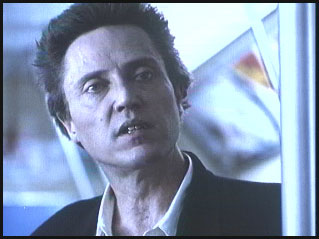
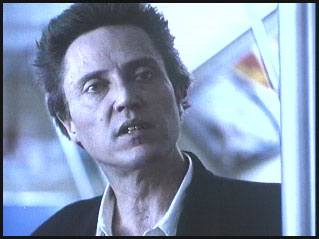
Walken on the Wild Side with the Big Bad Wolf from the Bronx


from an article by Adam Higginbotham, originally published in Neon magazine in 1997, which can be found in full here:

Late one Saturday night in 1993, Christopher Walken made a brief appearance on British television. He came looming out of the darkness, seated in a huge cane chair, wearing an iridescent pink, yellow and green pullover, a giant book of fairy tales in his lap. “Hello, children,” he said in the monotone of a Bronx assassin. “Are you sitting comfortably?” And he started to read aloud from The Story of The Three Little Pigs. “In the village there was a wolf. A big wolf. Big bad wolf. Get the picture?” The story quickly heated up: “Exit pig one. Pig two, same story. ‘I’ll huff and I’ll puff and I’ll blow your house down.’ Arrividerci, porco numero due. Buon giorno, salami.” His performance was hilarious. Practically no-one has ever seen it.

"Practically no-one" is a select constituency, but count me amongst it. Walken's wiseguy rendition of The Three Little Pigs (performed on Jonathan Ross's Saturday Zoo) was the funniest thing I've ever seen on tv. Nothing on Walken's Saturday Night Live dvd comes close (not even the celebrated "Cowbell Sketch"). To the best of my knowledge, the routine has never been re-broadcast and no-one I know has ever seen, or heard of, it. Without Higginbotham's testimomy I may have written it off as an hallucinatory product of my fevered imagination.

Higginbotham's excellent Walken on the Wild Side follows:

In 1959, When Christopher Walken was 16 years old, he didn't quite know what he wanted to do for a living. So he joined a travelling circus and became a lion tamer. Don't ask how. Don't ask why. The important thing is: he was there, in a circus run by a man named Tarryl Jacobs, with boots, jodhpurs, red jacket and whip. Billed as Tarryl Jacobs junior by the childless impresario, the young Walken would be left in the lion's cage at the end of "dad's" act, and all the lions but one would file out. Then Chris would crack his whip and the remaining beast, a tired, toothless lioness called Sheba, would wearily rise up on her podium and emit a feeble growl. The audience always gave him and Sheba a big hand.
In 1996, splayed awkwardly across an armchair in the lounge of the Chateau Marmont hotel, Walken laughs and licks his lips, illustrating the storv with exhausted-lion and whip-raising gestures. And then he stops, considering the freakishness of the image."
I just did it for two months. It was very weird. I was a kid. But that was interesting. That's where I come from. True story. Tarryl Jacobs -"dad" - would take his shirt off; and... it was like lions had been chewing on him for 25 years. He was just shredded all over the place. And that's what he did for a living. I don't know..... I guess he wasn't a very good lion tamer." Again he trails off; staring vacantly around the room. The tale, and the past it hints at, are perhaps what leads him not to take himself too seriously."
Absolutely. And also never to take a job like that again."

Christopher Walken is a very weird person. He is spooky, monosyllabic, unfriendly.
He shares many qualities with the characters he plays on screen - and they, by and large, are killers, gangsters, psychos, freaks and straight-up loonies. Walken is the guy who blew his brains out in The Deer Hunter. He is the remorseless drug lord in King Of New York. He is the man who executed Dennis Hopper in True Romance. He has an icy, alien air of distracted menace. Being in his company is like sharing a lift with Satan. He is deeply creepy.
That, at least, is what most people believe. Including his publicist. Forty-eight hours before the interview is due to begin, the phone rings. There is a problem with travelling to the photo studio in Mr Walken's car. "What you have to understand," crackles the strained voice from LA, "is that Chris is a very strange man. You know that character you see up on the screen? Well, that isn't a character. That's what he's like in real life. You can't go in the limousine with him. I can't go in the limousine with him."
Everybody, it seems, knows that Christopher Walken is King Weird.

But the man who glides smoothly into the lobby of the Chateau Marmont hotel in Los Angeles has neither the demeanour of a contract killer nor the manners of a sociopath. He is polite. He smiles. He has a sense of humour. He tells anecdotes. He has exquisite comic timing. But there is, undeniably, something strange about him. While his personality is plainly not that of the characters you see up on the screen, his gestures and mannerisms are: the shark's eyes that slide away from your gaze at the last moment; the blank stare into space; the thin smile that twitches on his lips as he listens to what you have to say; the flat, disinterested voice that makes even the most sincere statements sound sardonic and threatening; the reptilian lip-licking; the hand semaphore. All the things that go into the creation of the callous gangster, the psychotic angel or the demented industrialist are right here in front of you.

It's not difficult to get Walken talking. He's affable enough. But you can't really have a conversation with him. The disconcerting battery of pauses, stares and off-kilter rhythms that characterise his speech make that almost impossible. He leaves sentences hanging in mid-air, delivers ideas via a halting verbal cut-up technique. and says things like "I think that's very amusing" in a way which leaves you in no doubt that what he really means is "I'll have you killed."

At first, the makers of Things To Do in Denver When You’re Dead weren't sure who to cast in the part of the malevolent, paraplegic. wheelchair-bound mafioso The Man With The Plan. He can't move. yet for whole scenes Andy Garcia's character is required to stand there and watch him - through pages and pages of dialogue. And he must feel compelled to watch.
"He's sitting there - a head," says director Gary Fleder. "How manv guys out there can do that? Nicholson can do it. Probably Pacino. And then Chris Walken's a guy who can do it time and time again. You can just sit and watch him speak." Nonetheless, they hesitated to use him because he's played the captivating bad guy countless times before. In the end, they couldn't believe what they got. "He really out-Walkens Walken," says Denver writer Scott Rosenberg. "He's just so out there."
What is it with him? The mannerisms. The look. That hair. The intensity of his evil screen presence is derived direcdy from his everydav bearing. He is pleasant, but the otherness of his delivery does occasionally verge on performance. When he orders a glass of grapefruit juice, it seems possible the waiter will return offering the drink, the keys to his car, the deeds to his house, all the money in his pockets and the plea to "Just leave the kids out of it, OK?"
"My personality," Walken suggests, "is affected by the fact that I grew up differently from most people. Strangeness equates into villainy very easily. Just as a phobic thing. If you don't know what it is, you fear it. But I don't feel strange. I really don't feel strange."

The common perception of what Walken is like in real life is simply the wrong way around. All the frightening alien qualities vou see in the movies are real. The personality that informs them is not. The fact is not that Christopher Walken is like his characters, but that his characters are like him. He doesn't mean anything by it. That's just the way he is.
And the reasons he came to be this way are not what you might expect. Walken and his contemporaries - Pacino, De Niro, Keitel - have built careers around brutal depictions of grim reality. But Walken is the only actor of his generation who would call himself "a performer“ And he's certainly the only one who describes himself as working in "show business." If he's a bit odd, it's not because he suffered years of unspoken terrors on the streets of the Bronx. It's because he's a survivor of a world long gone. Because Christopher Walken began performing at the age of three.
"I grew up in show business," he says. "And it made me different."

Back in the late-'40s New York, things were very different indeed. For a start, Christopher Walken wasn't even called Christopher. He was born in 1943 and named Ronald, after Ronald Colman. He had two brothers: Glen and Ken. They lived in Astoria, Queens, where their father ran a bakery. Their mother, a vivacious, outgoing woman who might otherwise have been a performer herself, decided her sons should be in showbiz. Catalogue models as toddlers, they quickly graduated to TV, playing bit parts in the genesis of modem television: over 90 live TV shows went out every week from Manhattan, and Ronnie was there. He was on Howdy Doody, Philco TV Playhouse and The Colgate Comedy Hour.
By the time he was seven, he'd wander around the studios and find grown women dressed as cigarette packets. Or pass monkeys riding motor scooters. By the time he was ten, he'd already appeared on screen with Dean Martin, Sid Caesar and Jerry Lewis. It was a strange place - a naive and surreal area of conformist fantasy in which America created an image of what it wanted to be."
In those days all TV was See the USA in your Chevrolet'," says Walken. 'It was so family- oriented and wholesome that they used kids like furniture. They'd have a scene and - particularly in the holidays - they'd just stick a bunch of kids in there. They just had us there because everybody loves kids. It was an unusual childhood. but it was a great one. A total education of another sort."

Fifty years in show business have made Christopher Walken peculiar in many ways. He has never learned to swim. He has never been to a ball game. He's hard pushed to think of any close friends, except for his wife, who he's been married to for 27 years. He only reads the paper on Sundays. At home, he channel-surfs on cable, looking for old black and-white movies to watch.
"I don't have any hobbies. I don't have kids.... I have cats. I'm not really interested in too many things except my work. Whatever the best thing in front of me is, I usually take it. Because it's either that or sitting around at home, and I can't stand that. There's no scheme to it, what I do. It's, Have I been sitting around at home for two weeks? If I'm in the house for two weeks, I would, you know... I would play... anything."

On location, Walken always shops for his own food. He puts on a baseball cap and goes down to the supermarket. He hardly ever eats in restaurants. He doesn't want anyone else touching his food. He wants to know where it's been.
"I can't believe the things people eat. Particulary in this country'. The way we eat is just unbelievable. I wish this whole country would eat better. I figure a lot of diseases would diminish, don't you?" He sighs and looks away. "Americans with fast food it's. . . too bad." But if he does go to the supermarket, he has to get someone else to take him. He has a black Cadillac from which he's had all the chrome and markings removed. It looks just like a hearse. But he doesn't like to drive it much. When he does, he drives so slowly that other motorists blow their horns at him.
"And they scream as they go by. I drive very carefully. Listen, you know, I'd rather take chances in my work. I don't need to take any other chances. You would never get me on a motorcycle. I seriously doubt if I will ever get on a horse in a movie again. They're dangerous. There are things that are dangerous; you shouldn't do them. I mean, I look at someone bungee jumping, and I think, There goes another ass-hole. Or parachute jumping, for that matter. Unless you're dropping behind enemy lines, I really don't see the need for it."
He gazes around the room, and his stare comes to rest on the back of my hand, where there is an address written in black ballpoint."That's not permanent is it?" he asks, with concern. "People really do that to themselves, don't they?"

When he was old enough, Ronnie's mum sent him off on the subway to the Professional Children's School in Manhattan. Most of the pupils were girls ("it was like I had 40 sisters") and those that weren't were not your average brattish stage-school wannabes. Little Ronnie went to school with Sal Mineo, Frankie Lymon, Brandon De Wilde and Marvin Hamlisch. Marvin wrote an opera at ten and went on to become a phenomenally successful songwriter. Walken still knows him today. Frankie was 14 when he and his group The Teenagers had a huge international hit with "Why Do Fools Fall In Love?" But he was a heroin addict by 15; at 26, he was dead. Brandon played the kid in Shaize at ten and, one day in the men's room, taught Ronnie how to knot a tie. But his career tailed off and he died in a car crash at 30. Sal was in Rebel Without A Cause and Giant, but hardly worked after that. He drifted into darkness and obscurity and was stabbed to death at 37."It is," says Walken flatly, "a tough business."

After school, and on the weekends, Ronnie would go to the movies with his friends in Queens. He'd spend all day Saturday - from ten in the morning till four in the afternoon at the pictures. There would be 20 or 30 cartoons, three features and a serial Charlie Chan, The Molemen or, a particular favourite, the western The Laughing Man. A Lone Ranger clone, the Laughing Man would walk into a saloon where the bad guys were playing poker. His knife had a picture of him on the handle, and when he threw it into the table, it would quiver, animating the picture into a laugh. "And then he would, of course, destroy them all."
The features themselves were almost always war movies The Bridges Of Toko-Ri, Battle Cry or Pork Chop Hill. Anything with Aldo Ray was always good. Afterwards, the kids would adjourn to a nearby vacant lot and re-enact the story, crawling around in the dirt. Ronnie usually took the Aldo Ray part: "I was sort of heroic, sure," Walken says, somewhat defensivelv. "I was never the bad guy. I was always gonna take that hill!"
When he was 14, Ronnie saw Elvis Presley on The Ed Sullivan Show. He loved everything about him - especially his haircut. As soon as he could, Ronnie changed his hair to be more like The King's. It's stayed the same ever since.

Of all the tics, expressions and signifiers that make Walken's characters so mesmerisingly dark, the one at the heart of the black hole of menace is The Look. In all his most outstandingly grim moments - Frank White in King of New York watching his treacherous lieutenant plead pathetically for his life; Vincenzo Coccotti in True Romance torturing Dennis Hopper; The Man With The Plan making his deep displeasure felt - he will half smile and glance away. Mid-sentence, his eyes slide sideways and amusement plays on his lips. It's as if when he looks at you he already sees a dead man and is daydreaming about what spectacularly unpleasant things he's going to do his next victim. There's a supercomputer of evil in there behind the eyes, calculations and machinations beyond anyone's understanding. It's this cold-hearted, inhuman superiority that makes him so compelling. Mention this to Walken and he laughs. Mid-sentence, his eyes slide sideways and amusement plays on his lips. "I'm thinking about something else. What that could be is that I get suddenly fixated on something and it will interrupt my conversation. Something will happen and I'll get distracted. But that's what actors are supposed to be like - a little like kids, you know? Distraction is good. It means you're paying attention to what's going on - the way kids are. They'll talk to you and then they go" - he stares distractedly away into space.
"It's like, 'Next!"' OK, sure, sure. That's what you're like. But the characters. The machination. The superiority. Already seeing a dead man
"I don't think so." He smiles as if the thought has never occurred to him. "It's not in the characters. No. I think if you see that, it's me playing the part and suddenly thinking about something else. And then I come back to it. Suddenly, something crosses my mind. When I go to dailies and I see that kind of thing, I think that's perfectly natural, that's the way people are. Aren't you that way? When you talk to people aren't you also thinking that you mustn't forget to pick up your laundry?"
Walken is full of this kind of stuff If it's demystification you want, he's your man. He prepares for a part by reading his lines in different voices -Italian, Spanish, German, some slow, some fast, some serious passages in a Pee-Wee Herman voice - until he finds a common rhythm. He doesn't consciously develop his characters. He's never met anyone even remotely like the people he plays.
"I grew up with people in show business," he laughs in disbelief "We did not shoot each other. Really. That's the great thing about showbiz - everybody's really nice." He has no time for The Method. He just turns up and does it. "It boils down to: Can you act? Who cares what you think?"

The reason the set piece between Walken and Hopper in True Romance is so effective is that they got on well together offset. "First of all," Walken remembers, "he made me laugh, and that was very important in the scene. The fact that I was really enjoying this guy, and then I shoot him anyway. And the same is true of him - he really enjoyed telling me that story. And you could see it was delightful, don't you think? It happens to end with me shooting him in the head. But up until then, wasn't it delightful?" And if his characters' callousness is often so extreme that it seems funny, there's a simple reason for that, too: "I always know I'm in a movie. Having been in show business all my life, I'd feel hypocritical telling you it was real. That's just the thing I was brought up with. My acting technique comes directly out of musical comedy."

Walken wasn't much good with academic work, so he concentrated his teenage energies on becoming a dancer. He went on the road with touring musicals, the cast setting up home in cheap hotels up and down the country, taking their pots and pans and bohemian lifestyle with them. And, of course, he tried lion taming for a while. Then, at 18,just out of high school, when everyone else was leaving to go and take up ordinary lives, he spent a few days thinking about what to do. He'd drive down to the park in his car and gaze into the middle distance. Pragmatically, he thought, What do I like to do? Well. . . nothing. But how could he earn a living? He could be a bartender. He could drive a truck.......
"I really couldn't do anything. I wasn't good in school; but I was in show business. And I thought, Well, what could I do and have more fun? Nothing. So that's what I kept doing."
Just short of completing the first year of a course in English and Drama at Hofstra University, Ronnie Walken left education behind and went to dance OffBroadwav with Liza Minnelli in Best Foot Forward. The following year, he appeared in High Spirits and then in a brief run of the Sherlock Holmes musical Baker Street, in 1965. This somehow led to his first dramatic role, as King Philip Of France in The Lion In Winter.
In the meantime, Walken changed his name. He'd never liked Ronnie. It sounded too dorky. Dancing in a nightclub act with one Monique Van Vooren, at the end of every night's show she would introduce him to the audience. One night she said, "You know, I don't really like Ronnie. I see you more as a Christopher. Do you mind if I call you Christopher?" He didn't. So it was Christopher Walken who took to the stage as an actor, and danced and sang in musical comedies -"gee golly type of things". In 1969, while they were both appearing in a summer stock production of West Side Story, Christopher met his wife.

In the years since then, Christopher Walken has made a career from being the baddest thing ever to walk across a cinema screen. But it almost didn't happen like that at all. In 1970, he screentested for the Ryan O'Neal part in Love Story. It's difficult to imagine now. It was also, he points out, difficult to imagine then: "That's why I didn't get the part. They knew I wouldn't be any good in it."
He shouldn't have been surprised - he'd never been able to play Romeo on stage, either. Everything he said always sounded a bit sarcastic. In the end, his first film appearance was as Sean Connery's sidekick in the 1971 caper movie The Anderson Tapes. He was 28 years old.
But it would be another six years until he'd come to the attention of a wider audience: playing Diane Keaton's deranged brother Duane in Woody Allen's Annie Hall. He's only in the film for a few moments, but in those moments, he talks fixedly to Allen, Annie's visiting boyfriend, about his urge to drive his car into headlong traffic. "And actors tend to do things, and they stick. The romantic guy tends to play a lot of those kind of guys. The funny guy tends to play a lot of those kind of guys. And the first thing anybody saw me in, I talk about driving into headlong traffic."
Of course, winning an Oscar for blowing his brains out in The Deer Hunter probably didn't help much either. But from that point onwards, it was spooks, psychos and heavies all the way for Christopher Walken: The Dead Zone, Communion, A View To A Kill, Batman Returns, At Close Range, The Comfort of Strangers, Wayne's World 2. Pulp Fiction...loonies all. And the last time he played a hero?
"Never. A famous, big movie actor said to me once, 'Do you die in every movie?' And I thought about it and said, 'Yes.' He said to me, 'D'you know, I've never died."'"I'm not complaining about playing villains. It's how I make my living. But I'd love to play a hero. I'd love to play James Bond," he says, and then, in a slightly dejected register, "Nobody's going to ask me to play James Bond."

Walken never knows what kind of people his characters are until he sees them on the screen. If he's produced something particularly diabolical, he thinks to himself, Ooh, that's good. "I really do feel about it that way: Oh, that'll get 'em. Ooh, that's a good one. And if I think, Oh, gee, that didn't work, then I get depressed."
Of all his creations, the only one who's ever genuinely frightened him is the one in Paul Schrader's The Comfort Of Strangers - an Italian socialite who wines and dines Rupert Everett and then slits his throat. When it's brought up, it's the only point in our conversation that he looks plainly uncomfortable."
I don't think I've ever played anyone quite as horrible in the way that it can be deeply unsettling to be in a room with somebody who is mentally disturbed. As much as you have compassion for them, it scares me."
When he was shooting the film in Rome, he was sitting in his dressing room reading a book when he looked up and caught sight of himself in a mirror. He reacted to his reflection as you would if you walked into a restaurant and saw someone you really didn't want to meet. "I looked up and quickly looked away, thinking, I hope he leaves. I hope he didn't see me. But being the villain has its advantages. Since he made King Of New York, he can go pretty much anywhere he likes in the city, no matter how bad the area. One summer Saturday night a couple of years ago, he decided to go to Times Square to see a late show of the Hughes Brothers' ultra-violent Menace II Society.
"Everybody in the audience was like everybody in the movie. Street people. And they took good care of me. Just kept an eye out and made sure I was OK. 'Cause they'd seen King of New York. I'm a homeboy."

Of all the movies Walken has made, one of his favourite is also one of the most obscure: an '80s Israeli musical production of Puss In Boots. "It's very good. It's one of my best performances. It's a wonderful story - about a cat who gets these boots and becomes a man. In the original story he's just a cat who stands up and talks. But in this, it was this orange and white cat walking around, and then suddenly it would be me. I had my hair dyed red and I had a moustache and... I really looked like a cat. I sing and dance. It was very funny."

Christopher Walken is really not what you expect. He is not, to put it mildly, unaware of the way people see him. When he's shooting a movie, for instance, he'll just put on a reedy, nerdy voice before a take and say, "Is it hot in here, or am I crazy?""And for some reason people laugh," he adds. Sometimes he'll just announce that he's dedicating the take to Jerry Lewis. "And for some reason," he says. his face a mask of earnestness. "that makes people laugh also. Because of the way people perceive me, I can definitely have fun with it."

Despite the cable channel-surfing and the working every fortnight, he has managed to write a play about Elvis, based on the stories he's clipped from copies of The National Enquirer and Weekly World News he's bought on his Supermarket trips. And he's written a script about porn star John Holmes - a project he wants to star in, and Abel Ferrara to direct. When Holmes died of AIDS, he had had sex with 10,000 people. was a free-base cocaine addict and was wanted for murder. Elvis and Holmes are both men crushed by the pressures of fame, who died in middle age. Ferrara is quick to make the link. "Walken's obsessed with Holmes," he said in 1990. "He relates to all this because that's what 33 years in show business is like."

Just the other day, Christopher Walken bumped into an old friend in the street. They're the same age. They've known one another for years. At the time, Walken was on his way to see Things to do in Denver When You're Dead for the first time. So Walken invited the friend along, and they went to see the movie together. Afterwards, Walken noticed his friend was horrified by what he had just seen. "Jesus Christ." he muttered, "that's the most terrible person I ever saw . . . That's just the most terrible person I ever saw."

Christopher Walken looked back at his friend and said, very reasonably, "Well, thank you."

Tuesday, November 29, 2005

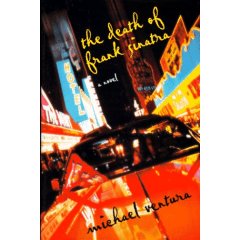
Sinatra ~ This American Life ~ Deconstructing the Chairman of the Board


from WBEZ in Chicago

Sinatra ~ This American Life

Of particular interest during this one hour show are the segments featuring Michael Ventura reading an excerpt from his novel The Death of Frank Sinatra (7.5 mins to 20 mins) and Gay Talese reading from his sublime Frank Sinatra Has a Cold, recently voted the best story Esquire ever published (38.5 mins to 48.5 mins).

The following link from WBEZ provides detailed info on the broadcast plus an audio link to an insightful interview with Michael Ventura, which didn't make the final cut.

WBEZ ~ TAL ~ Sinatra

Please note: these are Real Player audio files.

Gay Talese ~ Frank Sinatra Has a Cold


from Esquire.com

This wonderful article by Gay Talese originally appeared in Esquire magazine, April 1966. Gay Talese was credited by Tom Wolfe as the creator of "The New Journalism."

FRANK SINATRA, holding a glass of bourbon in one hand and a cigarette in the other, stood in a dark corner of the bar between two attractive but fading blondes who sat waiting for him to say something. But he said nothing; he had been silent during much of the evening, except now in this private club in Beverly Hills he seemed even more distant, staring out through the smoke and semidarkness into a large room beyond the bar where dozens of young couples sat huddled around small tables or twisted in the center of the floor to the clamorous clang of folk-rock music blaring from the stereo. The two blondes knew, as did Sinatra's four male friends who stood nearby, that it was a bad idea to force conversation upon him when he was in this mood of sullen silence, a mood that had hardly been uncommon during this first week of November, a month before his fiftieth birthday.

Sinatra had been working in a film that he now disliked, could not wait to finish; he was tired of all the publicity attached to his dating the twenty-year-old Mia Farrow, who was not in sight tonight; he was angry that a CBS television documentary of his life, to be shown in two weeks, was reportedly prying into his privacy, even speculating on his possible friendship with Mafia leaders; he was worried about his starring role in an hour-long NBC show entitled Sinatra- A Man And His Music, which would require that he sing eighteen songs with a voice that at this particular moment, just a few nights before the taping was to begin, was weak and sore and uncertain. Sinatra was ill. He was the victim of an ailment so common that most people would consider it trivial. But when it gets to Sinatra it can plunge him into a state of anguish, deep depression, panic, even rage. Frank Sinatra had a cold.

Sinatra with a cold is Picasso without paint, Ferrari without fuel -only worse. For the common cold robs Sinatra of that uninsurable jewel, his voice, cutting into the core of his confidence, and it affects not only his own psyche but also seems to cause a kind of psychosomatic nasal drip within dozens of people who work for him, drink with him, love him, depend on him for their own welfare and stability. A Sinatra with a cold can, in a small way, send vibrations through the entertainment industry and beyond as surely as a President of the United States, suddenly sick, can shake the national economy.

For Frank Sinatra was now involved with many things involving many people-his own film company, his record company, his private airline, his missile-parts firm, his real-estate holdings across the nation, his personal staff of seventy-five-which are only a portion of the power he is and has come to represent. He seemed now to be also the embodiment of the fully emancipated male, perhaps the only one in America, the man who can do anything he wants, anything, can do it because he has the money, the energy, and no apparent guilt. In an age when the very young seem to be taking over, protesting and picketing and demanding change, Frank Sinatra survives as a national phenomenon, one of the few prewar products to withstand the test of time. He is the champ who made the big comeback, the man who had everything, lost it, then got it back, letting nothing stand in his way, doing what few men can do: he uprooted his life, left his family, broke with everything that was familiar, learning in the process that one way to hold a woman is not to hold her. Now he has the affection of Nancy and Ava and Mia, the fine female produce of three generations, and still has the adoration his children, the freedom of a bachelor, he does not feel old, he makes old men feel young, makes them think that if Frank Sinatra can do it, it can be done; not that they could do it, but it is still nice for other men to know, at fifty, that it can be done.

But now, standing at this bar in Beverly Hills, Sinatra had a cold, and he continued to drink quietly and he seemed miles away in his private world, not even reacting when suddenly the stereo in the other room switched to a Sinatra song, In the Wee Small Hours of the Morning.

It is a lovely ballad that he first recorded ten years ago, and it now inspired many young couples who had been sitting, tired of twisting, to get up and move slowly around the dance floor, holding one another very close. Sinatra's intonation, precisely clipped, yet full and flowing, gave a deeper meaning to the simple Iyrics-"In the wee small hours of the morning/while the whole wide world is fast asleep/you lie awake, and think about the girl .."-it was, like so many of his classics, a song that evoked loneliness and sensuality, and when blended with the dim light and the alcohol and nicotine and late-night needs, it became a kind of airy aphrodisiac. Undoubtedly the words from this song, and others like it, had put millions in the mood, it was music to make love by, and doubtless much love had been made by it all over America at night in cars, while the batteries burned down, in cottages by the lake, on beaches during balmy summer evenings, in secluded parks and exclusive penthouses and furnished rooms, in cabin cruisers and cabs and cabanas-in all places where Sinatra's songs could be heard were these words that warmed women, wooed and won them, snipped the final thread of inhibition and gratified the male egos of ungrateful lovers; two generations of men had been the beneficiaries of such ballads, for which they were eternally in his debt, for which they may eternally hate him. Nevertheless here he was, the man himself, in the early hours of the morning in Beverly Hills, out of range.

The two blondes, who seemed to be in their middle thirties, were preened and polished, their matured bodies softly molded within tight dark suits. They sat, legs crossed, perched on the high bar stools. They listened to the music. Then one of them pulled out a Kent and Sinatra quickly placed his gold lighter under it and she held his hand, looked at his fingers: they were nubby and raw, and the pinkies protruded, being so stiff from arthritis that he could barely bend them. He was, as usual, immaculately dressed. He wore an oxford-grey suit with a vest, a suit conservatively cut on the outside but trimmed with flamboyant silk within; his shoes, British, seemed to be shined even on the bottom of the soles. He also wore, as everybody seemed to know, a remarkably convincing black hairpiece, one of sixty that he owns, most of them under the care of an inconspicuous little grey-haired lady who, holding his hair in a tiny satchel, follows him around whenever he performs. She earns $400 a week. The most distinguishing thing about Sinatra's face are his eyes, clear blue and alert, eyes that within seconds can go cold with anger, or glow with affection, or, as now, reflect a vague detachment that keeps his friends silent and distant.

Leo Durocher, one of Sinatra's closest friends, was now shooting pool in the small room behind the bar. Standing near the door was Jim Mahoney, Sinatra's press agent, a somewhat chunky young man with a square jaw and narrow eyes who would resemble a tough Irish plainclothesman if it were not for the expensive continental suits he wears and his exquisite shoes often adorned with polished buckles. Also nearby was a big, broad-shouldered two-hundred-pound actor named Brad Dexter who seemed always to be thrusting out his chest so that his gut would not show.

Brad Dexter has appeared in several films and television shows, displaying fine talents as a character actor, but in Beverly Hills he is equally known for the role he played in Hawaii two years ago when he swam a few hundred yards and risked his life to save Sinatra from drowning in a riptide. Since then Dexter has been one of Sinatra's constant companions and has been made a producer in Sinatra's film company. He occupies a plush office near Sinatra's executive suite. He is endlessly searching for literary properties that might be converted into new starring roles for Sinatra. Whenever he is among strangers with Sinatra he worries because he knows that Sinatra brings out the best and worst in people-some men will become aggressive, some women will become seductive, others will stand around skeptically appraising him, the scene will be somehow intoxicated by his mere presence, and maybe Sinatra himself, if feeling as badly as he was tonight, might become intolerant or tense, and then: headlines. So Brad Dexter tries to anticipate danger and warn Sinatra in advance. He confesses to feeling very protective of Sinatra, admitting in a recent moment of self-revelation: "I'd kill for him."

While this statement may seem outlandishly dramatic, particularly when taken out of context, it nonetheless expresses a fierce fidelity that is quite common within Sinatra's special circle. It is a characteristic that Sinatra, without admission, seems to prefer: ALL The Way; All Or Nothing At All. This is the Sicilian in Sinatra; he permits his friends, if they wish to remain that, none of the easy Anglo-Saxon outs. But if they remain loyal, then there is nothing Sinatra will not do in turn-fabulous gifts, personal kindnesses, encouragement when they're down, adulation when they're up. They are wise to remember, however, one thing. He is Sinatra. The boss. Il Padrone.

I had seen something of this Sicilian side of Sinatra last summer at Jilly's saloon in New York, which was the only other time I'd gotten a close view of him prior to this night in this California club. Jilly's, which is on West Fifty-second Street in Manhattan, is where Sinatra drinks whenever he is in New York, and there is a special chair reserved for him in the back room against the wall that nobody else may use. When he is occupying it, seated behind a long table flanked by his closest New York friend who include the saloonkeeper, Jilly Rizzo, and Jilly's azure-haired wife, Honey, who is known as the "Blue Jew"-a rather strange ritualistic scene develops. That night dozens of people, some of them casual friends of Sinatra's, some mere acquaintances, some neither, appeared out side of Jilly's saloon. They approached it like a shrine. They had come to pay respect. They were from New York, Brooklyn, Atlantic City, Hoboken. They were old actors, young actors, former prize fighters, tired trumpet players, politicians, a boy with a cane. There was a fat lady who said she remembered Sinatra when he used to throw the Jersey Observer onto her front porch in 1933. There were middle-aged couples who said they had heard Sinatra sing at the Rustic Cabin in 1938 and "We knew then that he really had it!" Or they had heard him when he was with Harry James's band in 1939, or with Tommy Dorsey in 1941 ("Yeah, that's the song, I'll Never Smile Again-he sang it one night in this dump near Newark and we danced ..."); or they remembered that time at the Paramount with the swooners, and him with those bow ties, The Voice; and one woman remembered that awful boy she knew then-Alexander Dorogokupetz, an eighteen-year-old heckler who had thrown a tomato at Sinatra and the bobby-soxers in the balcony had tried to flail him to death. Whatever became of Alexander Dorogokupetz? The lady did not know.

And they remembered when Sinatra was a failure and sang trash like Mairzy Doats, and they remembered his comeback and on this night they were all standing outside Jilly's saloon, dozens of them, but they could not get in. So some of them left. But most of them stayed, hoping that soon they might be able to push or wedge their way into Jilly's between the elbows and backsides of the men drinking three-deep at the bar, and they might be able to peek through and see him sitting back there. This is all they really wanted; they wanted to see him. And for a few moments they gazed in silence through the smoke and they stared. Then they turned, fought their way out of the bar, went home.

Some of Sinatra's close friends, all of whom are known to the men guarding Jilly's door, do manage to get an escort into the back room. But once they are there they, too, must fend for themselves. On the particular evening, Frank Gifford, the former football player, got only seven yards in three tries. Others who had somehow been close enough to shake Sinatra's hand did not shake it; instead they just touched him on the shoulder or sleeve, or they merely stood close enough for him to see them and, after he'd given them a wink of recognition or a wave or a nod or called out their names (he has a fantastic memory for first names), they would then turn and leave. They had checked in. They had paid their respects. And as I watched this ritualistic scene, I got the impression that Frank Sinatra was dwelling simultaneously in two worlds that were not contemporary.

On the one hand he is the swinger-as he is when talking and joking with Sammy Davis, Jr., Richard Conte, Liza Minelli, Bernice Massi, or any of the other show-business people who get to sit at the table; on the other, as when he is nodding or waving to his paisanos who are close to him (Al Silvani, a boxing manager who works with Sinatra's film company; Dominic Di Bona, his wardrobe man; Ed Pucci, a 300-pound former football lineman who is his aide-de-camp), Frank Sinatra is Il Padrone. Or better still, he is what in traditional Sicily have long been called uomini rispettati - men of respect: men who are both majestic and humble, men who are loved by all and are very generous by nature, men whose hands are kissed as they walk from village to village, men who would personally go out of their way to redress a wrong.

Frank Sinatra does things personally. At Christmas time, he will personally pick dozens of presents for his close friends and family, remembering the type of jewelry they like, their favorite colors, the sizes of their shirt and dresses. When a musician friend's house was destroyed and his wife was killed in a Los Angeles mud slide a little more than a year ago, Sinatra personally came to his aid, finding the musician a new home, paying whatever hospital bills were left unpaid by the insurance, then personally supervising the furnishing of the new home down to the replacing of the silver ware, the linen, the purchase of new clothing.

The same Sinatra who did this can, within the same hour, explode in a towering rage of intolerance should a small thing be incorrectly done for him by one of his paisanos. For example, when one of his men brought him a frankfurter with catsup on it, which Sinatra apparently abhors, he angrily threw the bottle at the man, splattering catsup all over him. Most of the men who work around Sinatra are big. But this never seems to intimidate Sinatra nor curb his impetuous behavior with them when he is mad. They will never take a swing back at him. He is II Padrone.

At other times, aiming to please, his men will overreact to his desires: when he casually observed that his big orange desert jeep in Palm Springs seemed in need of a new painting, the word was swiftly passed down through channels, becoming ever more urgent as it went, until finally it was a command that the jeep be painted now, immediately, yesterday. To accomplish this would require the hiring of a special crew of painters to work all night, at overtime rates; which, in turn, meant that the order had to be bucked back up the line for further approval. When it finally got back to Sinatra's desk, he did not know what it was all about; after he had figured it out he confessed, with a tired look on his face, that he did not care when the hell they painted his jeep.

Yet it would have been unwise for anyone to anticipate his reaction, for he is a wholly unpredictable man of many moods and great dimension, a man who responds instantaneously to instinct-suddenly , dramatically, wildly he responds, and nobody can predict what will follow. A young lady named Jane Hoag, a reporter at Life's Los Angeles bureau who had attended the same school as Sinatra's daughter, Nancy, had once been invited to a party at Mrs. Sinatra's California home at which Frank Sinatra, who maintains very cordial relations with his former wife, acted as host. Early in the party Miss Hoag, while leaning against a table, accidentally with her elbow knocked over one of a pair of alabaster birds to the floor, smashing it to pieces. Suddenly, Miss Hoag recalled, Sinatra's daughter cried, "Oh, that was one of mother's favorite ..."-but before she could complete the sentence, Sinatra glared at her, cutting her off, and while forty other guests in the room all stared in silence, Sinatra walked over, quickly with his finger flicked the other alabaster bird off the table, smashing it to pieces, and then put an arm gently around Jane Hoag and said, in a way that put her completely at ease, "That's okay, kid."

More here

They Shoot Helicopters Don't They? How journalists spread rumors during Katrina.

from reason.com

On September 1, 72 hours after Hurricane Katrina ripped through New Orleans, the Associated Press news wire flashed a nightmare of a story: “Katrina Evacuation Halted Amid Gunfire…Shots Are Fired at Military Helicopter.”

The article flew across the globe via at least 150 news outlets, from India to Turkey to Spain. Within 24 hours commentators on every major American television news network had helped turn the helicopter sniper image into the disaster’s enduring symbol of dysfunctional urbanites too depraved to be saved.

Golfer Tiger Woods spoke for many of us on September 2 when he remarked, during a tournament in Boston, that “it’s just unbelievable…how people are behaving, with the shootings and now the gang rapes and the gang violence and shooting at helicopters who are trying to help out and rescue people.”

Like many early horror stories about ultra-violent New Orleans natives, whether in their home city or in far-flung temporary shelters, the A.P. article turned out to be false.

more here

Matt Welch